Exclusive interview

Marcin Pawlowski from Inchcape on navigating the new rules of search in the AI era

Are smaller car brands using AI better than the giants?

Will you lose one-third of your best traffic because of AI?

Which AI solutions are promising and which overhyped?

We sat down with Marcin Pawlowski, Website and Search Marketing Manager for Europe at Inchcape, to get a clear-eyed view from the automotive front lines.

We cut through the hype to discuss what really works, what doesn’t, and how to navigate the shift from SEO to GEO (Generative Engine Optimization).

aio geo inchcape

You just came back from a marketing summit and mentioned that people are hungry for knowledge about AI. Why do you think that is?

Marcin: The marketing environment is undergoing a fundamental shift. New tools like Google’s AI Overviews (AIO) are changing the way people access information online. Instead of visiting a brand’s website, users increasingly consume answers directly on the search results page.

For marketers, this means they still see strong demand, but the traffic doesn’t reach their websites anymore. This creates uncertainty because communication with customers happens in new spaces they can’t fully control. Many marketers simply don’t know how to adapt, and that’s why discussions about AI draw so much attention.

At the summit I attended, my session ran almost twice as long as planned because the audience was deeply engaged. They sense the shift, but lack clear strategies for handling it.


What’s the difference between AIO and GEO?

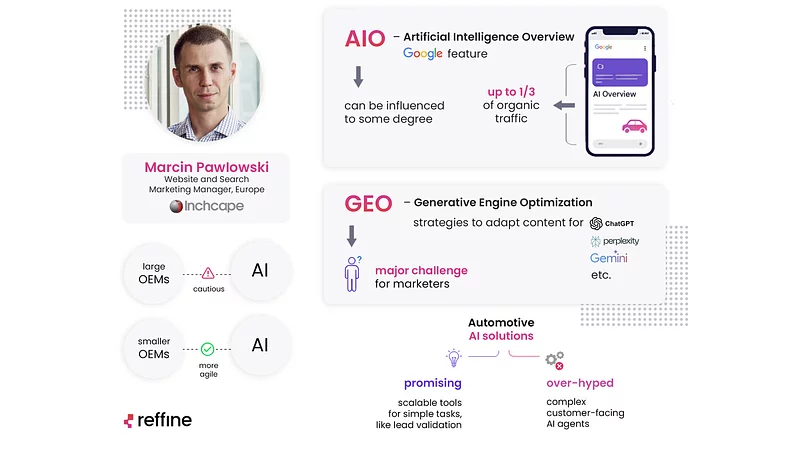
Marcin: AIO stands for Artificial Intelligence Overview. It’s Google’s new feature, launched in Poland in March and scaled across Europe between March and May. It appears at the very top of search results and can take away up to a third of organic traffic.

And that’s significant: organic traffic tends to convert best, so losing it is a major challenge.

GEO, on the other hand, means Generative Engine Optimization. This is the practice of shaping content so that generative AI tools - like ChatGPT, Perplexity, or others - pick it up and surface it to users.

You can think of AIO as a feature, while GEO is the emerging discipline that companies need to master in order to stay visible in this new landscape.


aio geo inchcape
changan auto ai bots leads process

English version of the graphic:

ernie byd AI use

The Results: A New Industry Standard

The platform delivered staggering improvements across key metrics:

  • Lead Processing Capacity: Increased by 3x.
  • Manual Operation Costs: Reduced by 35%.
  • Sales Conversion Rate: Improved by 20%.
  • Return on Investment (ROI): Double the industry average.

Direct Sales Impact: Generated over 10,000 new vehicle sales from theleads transformed in its initial phases.

Fan Longxiang, Chief Digital Marketing Officer, Changan Auto

Why It Matters: A Blueprint for the Industry

  • Micro-Lift, Macro-Impact: In an industry hovering below 1% conversion, Changan proved that even a fractional improvement translates to thousands of car sales and hundreds of millions in revenue.
  • A Proven Blueprint: This case study provides a clear roadmap for competitors. Rivals like BYD, NIO, and Wuling are already deploying similar AI dialers and automated WeChat flows to catch up.

The Future is Data Circulation: The real innovation is creating a closed-loop system where data from every step, from ad spend to a lost lead, informs and improves the entire process.

Finally, we’ve reached a time period when the John Wanamaker quote, 'Half the money I spend on advertising is wasted; the trouble is I don't know which half,' can be solved with AI. Lead validation issues are universal above borders and potential solutions can work as well on DeepSeek as in Sonnet LLM model or OpenAI. AI enabled the development of those solutions and improved process efficiency by a huge margin, says Adam Wardach, CEO, Reffine.

The Road Ahead: A Marathon, Not a Sprint

While these results are groundbreaking, Fan Longxiang remains pragmatic, emphasizing that true digital transformation is a long-term game:

To be honest, the automotive sector still has a long way to go in digital capabilities... In the first 3-5 years, you may see limited results, but after 7-8 years, companies typically reach a break-even point and may even see high returns.

Changan Auto's journey shows that while the initial investment in AI and data infrastructure is significant, the payoff is a powerful, sustainable competitive advantage that will redefine the future of retail.

Stay ahead

Subscribe to our newsletter and stay up to date with AI in Automotive

Every two weeks our analysts sift through both mainstream English white papers and the harder-to-find Chinese-language articles and reports, so you get a full 360° view of how AI is reshaping the automotive world. Want it delivered straight to your inbox? Subscribe now on LinkedIn and stay a step ahead: